
How Arrest Warrants Work in Franklin County
An arrest warrant in Franklin County is criminal process tied to a complaint or accusation. District judges, county judges, and authorized clerk magistrates may all issue one. That power is broad. Lower criminal, traffic, infraction, and ordinance matters generally sit in County Court, while felony cases move to District Court after the preliminary stage. A warrant search can begin with the JUSTICE case-information search, followed by a call to the issuing clerk. The Franklin County Sheriff's Office handles process, service, jail, and custody. It posts no public warrant roster.
- Locate the case by legal name and confirm the county and court.
- Read the register of actions and offense entry.
- Ask the clerk whether a warrant, summons, return, or bond order controls.
- Call the sheriff about service or custody routing.
- Have an attorney advise on an appearance, surrender, bond, or motion.
Franklin County Arrest Process Issuers
Who signs the paper matters. Section 29-403 names district judges, county judges, and authorized clerk magistrates as officials who may issue process. Section 29-404 governs the complaint. Those statutes set the framework, not the details. The judge, the issue date, and any local code on a particular warrant live only in the court file. That file also sorts a Franklin County warrant search. A County Court file may hold a misdemeanor or a felony preliminary hearing. A District Court file carries the felony trail, and the clerk can say which court owns the document and what public copy, docket entry, or return is available.
| Issuing point | Franklin role | First question |
|---|---|---|
| County Court | Lower criminal matters and preliminary hearings | Does the docket show process or a required appearance? |
| District Court | Felony files and district matters | Which filing or order controls the felony case? |
| Clerk magistrate | Authorized process and County Court duties | What action is recorded, and where is the warrant return? |
Franklin County Arrest Warrant Direction
Nebraska §29-406 directs a warrant to the sheriff or to a city or village marshal or police officer. The paper carries the accusation and the command needed to execute it. Section 29-407 covers who may execute process. So the issuing court and the server can differ. That split surprises people. Franklin County's sheriff holds the documented county role for legal process, arrests, jail custody, court attendance, and extradition. City coverage needs care. Franklin's official city pages route the police channel to the Franklin County Sheriff, and a 2026 notice discusses a possible transition in service. Ask who serves the process today. For the exact wording, read Nebraska §29-406; the statutory text shows the direction, the accusation, and the command the statute requires.
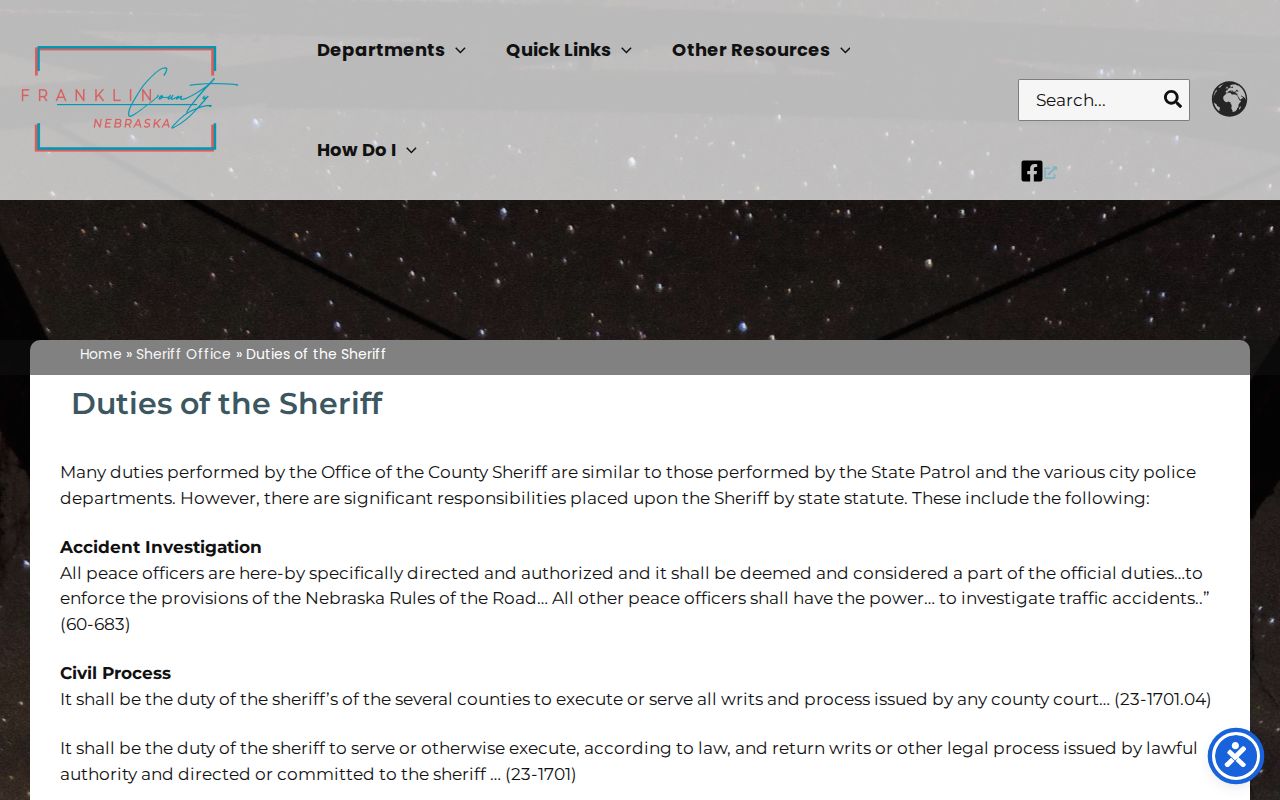
The statute draws a clean line in Franklin County: the court issues the warrant, and the officer receives it and carries it out.
Arrest Warrants: What They Contain
Franklin County publishes no sample warrant. Treat what follows as a field guide only. It is not a local form. Ask the clerk for the public case or document, then ask the sheriff for the service return.
| Case or warrant number | Nebraska court case number; Franklin's exact warrant format was not found. |
|---|---|
| Issue date and court | Date, judge or magistrate, and County Court or District Court. |
| Complaint or offense | Accusation, statute, class, and supporting filing when public. |
| Probable-cause basis | Ask the clerk what document is public; do not infer from a search summary. |
| Bond or release | Amount or condition, if recorded and releasable; no Franklin schedule was located. |
| Service and status | Addressee, execution or return, and a current active, served, recalled, or quashed entry. |
Franklin County Arrest Court Trail
Franklin County's court map is compact. County Court handles the preliminary stage and a broad set of lower-court cases. District Court is the felony-level trial court and also hears appeals from County Court. A person may therefore see a County Court entry before the felony case continues in District Court.
Call Marcia Volk-Schenker at 308-425-6202 for the District Court clerk route. The official profile gives P.O. Box 146, Franklin, Nebraska 68939. Call Darcie Porter at 308-425-6288 for County Court. Use the state court profile for Franklin District Court contact.
The District Court contact image below identifies the court channel.
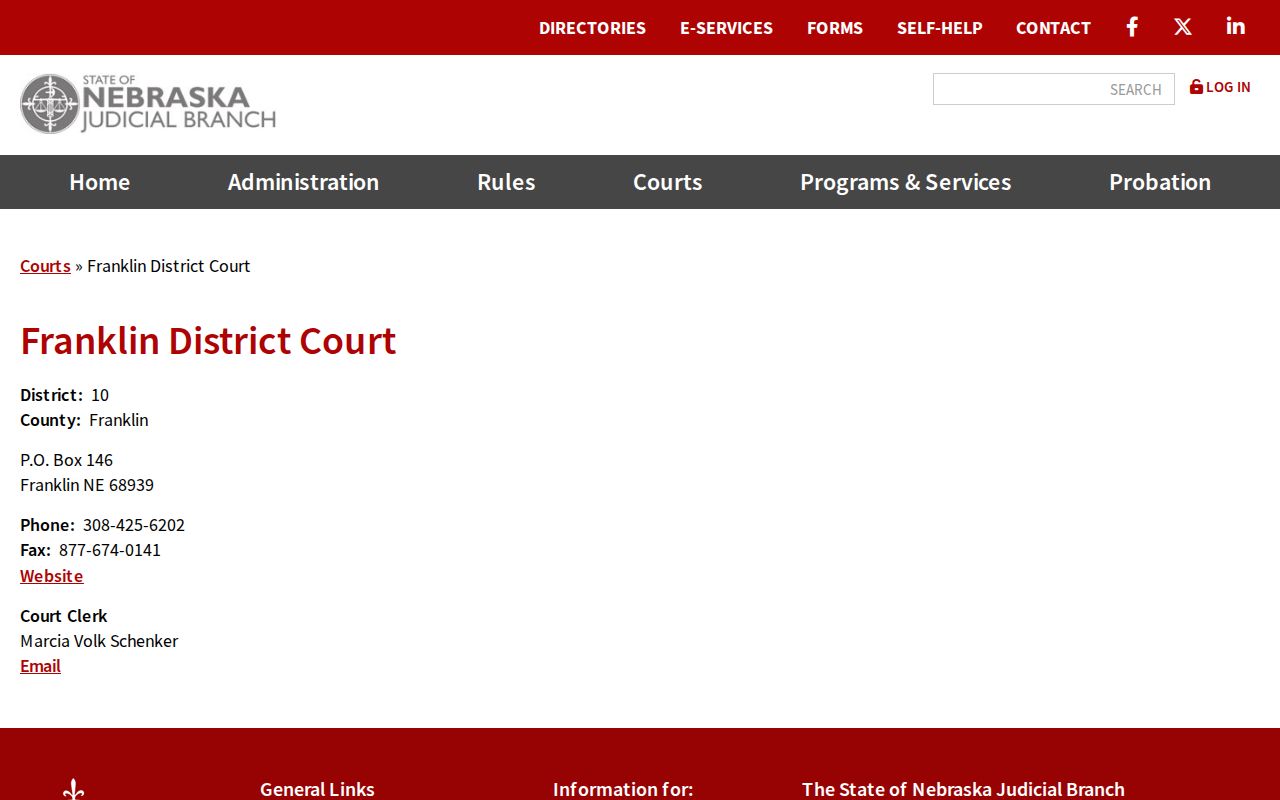
The court level should be confirmed before any appearance or request.
How Warrants Get Served in Franklin County
Under §29-406, a warrant can be directed to the sheriff, a city or village marshal, or a police officer. The sheriff's duties page is plain. It lists service of legal process and jail custody. The city route can shift, so confirm the serving agency before you act. One call may not settle everything. Ask the sheriff whether your question concerns service, a return, custody, or a court instruction. Ask the clerk about the underlying case. Each office has its lane. The sheriff will not walk you through every docket entry, and the clerk cannot quote live jail status without checking the right office. Franklin County callers who try both offices get the full picture.
Franklin County Sheriff's Office
405 15th Avenue
Franklin, NE 68939
308-425-6231
Read the Sheriff duties page for the documented process role.
Arrest Warrants, Summonses, and Bench Warrants
These terms mark different court routes. A summons calls a person to court without an arrest command. A bench warrant usually follows a missed setting or other noncompliance, while an arrest warrant is process on a criminal complaint. In Franklin County, the underlying case continues after any custody or release step.
| Process | What starts it | Who to ask |
|---|---|---|
| Summons | Court notice to appear | Issuing clerk |
| Bench or FTA warrant | Missed setting or noncompliance | Court that set the date |
| Arrest warrant | Complaint and criminal process | Issuing court and sheriff |
The court record, not a generic label, controls which process appears in Franklin County.
Franklin County Arrest Service Routing
Franklin's official city page labels the police channel as the Franklin County Sheriff's Department. A September 2026 notice tells a different story. The city was weighing dissolution of its separate Police Department and negotiating enforcement services with the county sheriff. That shift is a service fact. It does not create a new warrant portal for Franklin County. For city-originated process, the working questions are which office holds the case and which agency serves it today. Prior police numbers and old service assumptions go stale. The official Franklin transition notice and the city government listing carry the current routing for Franklin County.
Search Warrants and Arrest Warrants Differ
Two different tools, two different jobs. A search warrant lets officers enter and examine a place, a person, or property, while an arrest warrant puts someone in custody on a criminal accusation. Nebraska sets the bar for the first one in §29-814.04. That statute demands probable cause, a clear description of the place or person, the property to seize, and the officer who will execute it. Treat the two records separately in Franklin County. Never let one status claim cover both. For a search-warrant question, ask the issuing court what is public and whether an exception applies; for an arrest warrant, ask about the case, service, bond, and appearance. The state search-warrant rule sits at §29-814.04.
Do not assume: a court case that mentions a search does not automatically show an arrest warrant, and a criminal history response does not prove current warrant status.
Handling an Arrest Warrant in Your Name
Pick up the phone before you walk in. Call the issuing clerk and the sheriff first, and ask whether an attorney can arrange a walk-through, a reset, bond, or a motion. Franklin County publishes no surrender hours, bond window, payment methods, or recall form. So the court itself is your only source for those details. After an arrest, §29-412 governs taking the person before a magistrate. Covered failure-to-pay or failure-to-appear matters may also get the hearing described in §29-2412. Neither rule replaces a direct call about your actual case.
Get advice first. A lawyer can read the docket and ask the court how to resolve the process. Do not rely on a blank search or a third-party status.
A written request under Nebraska's Public Records Act can fill the gap when a Franklin County record is missing.